Qwen 2 vs Gemini 1.5 Pro
The AI race in 2025 is no longer just about who can generate better text. It’s about scale, intelligence, adaptability, and real-world usefulness. Two names that keep popping up in serious AI discussions are Qwen 2 and Gemini 1.5 Pro. One is often praised as a polyglot AI model capable of handling multiple languages and tasks with ease, while the other is seen as a titan—a massive, enterprise-grade system built for deep reasoning and enormous context handling.
But which one actually stands out? Is Qwen 2 the flexible multilingual brain developers love, or is Gemini 1.5 Pro the unstoppable powerhouse redefining advanced AI reasoning? Let’s break it all down in a clear, human way—no hype, no fluff, just real comparison.
Understanding the Vision Behind Qwen 2
Qwen 2 comes from Alibaba’s growing AI ecosystem, and its philosophy is immediately clear: make AI practical, multilingual, and developer-friendly. From the start, the Qwen 2 model has been positioned as a strong contender in multilingual AI, handling English, Chinese, and many other languages with impressive fluency.
What makes Qwen 2 interesting is how naturally it switches between languages without losing tone or context. This polyglot AI model doesn’t just translate—it thinks across languages. That makes it particularly appealing for global applications, content platforms, and cross-border businesses.
Beyond language, Qwen 2 also focuses heavily on usability. Developers often highlight how approachable it feels when working on coding tasks, documentation, or even creative writing. It’s not trying to overpower the user with complexity; instead, it aims to collaborate.
Gemini 1.5 Pro and the Rise of the Titan Model
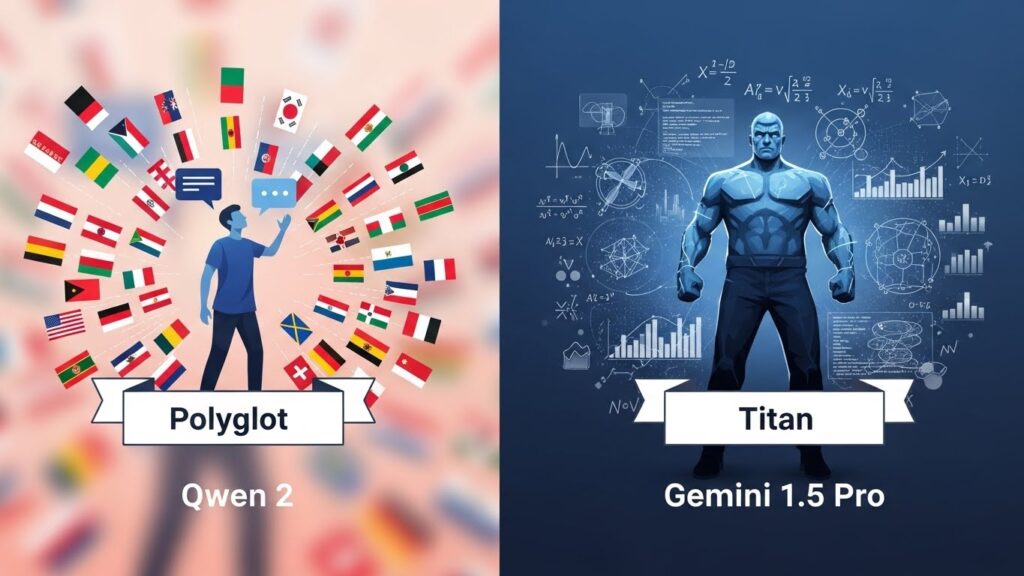
Gemini 1.5 Pro, built by Google DeepMind, plays in a different league altogether. This model is designed as an advanced reasoning model capable of handling some of the largest context windows ever seen in consumer-accessible AI. When people talk about the Gemini 1.5 Pro AI, they often mention its ability to process entire books, massive codebases, or hours of transcripts in a single session.
This is where the “titan” label fits perfectly. Gemini 1.5 Pro isn’t just about language—it’s about memory, reasoning depth, and enterprise-grade performance. It’s engineered to solve problems that smaller models simply can’t hold in their working memory.
For research teams, corporations, and developers building complex systems, Gemini 1.5 Pro feels less like a chatbot and more like a powerful analytical engine.
Polyglot Strength vs Reasoning Depth
One of the most interesting contrasts in the Qwen 2 vs Gemini 1.5 Pro debate is language versatility versus reasoning scale.
Qwen 2 shines when it comes to multilingual AI performance. Whether you’re writing content in mixed languages, handling international customer queries, or generating localized marketing copy, the Qwen 2 model feels smooth and natural. It’s especially strong in Asian languages, which gives it a unique edge in global markets.
Gemini 1.5 Pro, on the other hand, focuses less on being a polyglot and more on being a deep thinker. Its reasoning abilities, long-context understanding, and analytical consistency make it ideal for tasks like legal document analysis, scientific research, and large-scale software planning.
So the question becomes: do you need linguistic flexibility or cognitive power at scale?
Coding Performance and Developer Experience
When it comes to AI for developers, both models bring serious value—but in different ways.
Qwen 2 is often praised for its approachable coding performance. It handles common programming languages well, explains code in a friendly manner, and feels responsive during iterative development. Many developers find it useful for debugging, writing scripts, and generating documentation without overcomplicating things.
Gemini 1.5 Pro, however, is built for complexity. Its ability to ingest massive repositories and maintain consistency across thousands of lines of code makes it ideal for enterprise development teams. The large context window allows it to understand architecture-level decisions rather than just isolated snippets.
In short, Qwen 2 feels like a helpful coding partner, while Gemini 1.5 Pro feels like a senior architect reviewing your entire system.
Context Window: A Game-Changing Difference
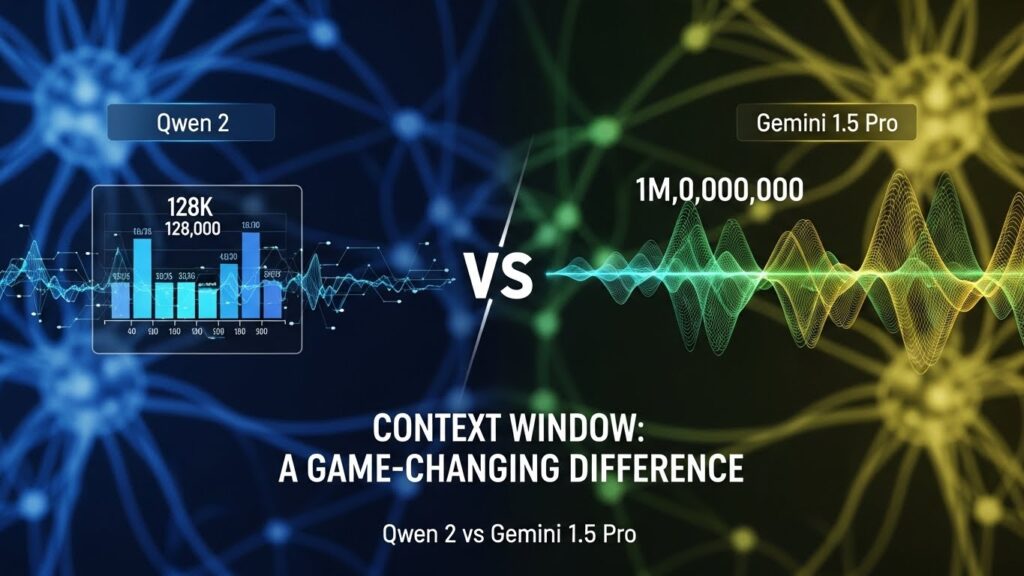
One of the biggest technical gaps between these two models lies in context window size. Gemini 1.5 Pro is famous for its extremely large context window, which allows it to process and remember vast amounts of information in one go. This is a massive advantage for tasks involving long documents, multi-step reasoning, or historical analysis.
Qwen 2, while efficient, operates with a more standard context size. This doesn’t make it weak—it just means it’s optimized for everyday tasks rather than extreme data ingestion. For most users, this is perfectly sufficient.
But if your workflow involves analyzing entire books, legal contracts, or long research papers, Gemini 1.5 Pro clearly dominates this area.
Performance in Real-World Applications
In real-world usage, Qwen 2 often feels faster and more lightweight. It responds quickly, adapts well to conversational tone, and doesn’t overwhelm users with overly complex explanations. This makes it ideal for customer support bots, content creation tools, and educational platforms.
Gemini 1.5 Pro, meanwhile, excels in environments where precision matters more than speed. Its responses tend to be structured, deeply reasoned, and sometimes more formal. This aligns perfectly with enterprise AI use cases, data analysis, and strategic planning.
The difference isn’t about which is “better,” but rather where each model fits best.
Multimodal Capabilities and Future Potential
Both Qwen 2 and Gemini 1.5 Pro are part of the broader trend toward next-gen language models that go beyond text. Gemini, backed by Google’s ecosystem, has a strong advantage in multimodal integration, including images, documents, and potentially video analysis.
Qwen 2 is also evolving in this direction, but its current strength remains firmly rooted in text-based intelligence and multilingual understanding. As Alibaba continues to invest, it’s likely we’ll see rapid improvements in multimodal support.
This makes the future comparison even more interesting, as both models are clearly built with long-term scalability in mind.
Accessibility and Ecosystem Support
Another practical factor is ecosystem access. Gemini 1.5 Pro benefits from Google’s infrastructure, making it deeply integrated into tools used by enterprises, researchers, and cloud developers. This makes adoption easier for organizations already within the Google ecosystem.
Qwen 2, on the other hand, appeals strongly to open-source communities and developers who want more flexibility. Its growing adoption in Asia and among multilingual developers gives it a unique cultural and technical footprint.
Accessibility often matters just as much as raw performance, especially for startups and independent creators.
Security, Reliability, and Trust
In enterprise environments, trust is critical. Gemini 1.5 Pro is built with enterprise-grade security and compliance in mind, which makes it a strong choice for regulated industries. Its consistent reasoning and structured outputs reduce the risk of unpredictable behavior.
Qwen 2, while reliable, feels more experimental and flexible. This isn’t a weakness—it’s actually a strength for innovation-driven projects—but it may require additional validation in high-risk use cases.
Final Verdict: Polyglot or Titan?
So, Qwen 2 vs Gemini 1.5 Pro: Polyglot or Titan? The answer depends entirely on your needs.
If you want a multilingual AI that feels natural, accessible, and adaptable for everyday use, Qwen 2 stands out as a true polyglot. It’s friendly, efficient, and ideal for global content and development tasks.
If you need an advanced reasoning model capable of handling massive data, deep analysis, and enterprise-level challenges, Gemini 1.5 Pro is undeniably the titan. Its sheer scale and intelligence set it apart in high-stakes environments.
In reality, both models represent different philosophies of AI—and both are winning in their own domains.
FAQs
1. Is Qwen 2 better than Gemini 1.5 Pro for multilingual tasks?
Yes, Qwen 2 generally performs better in multilingual and cross-language content creation.
2. Does Gemini 1.5 Pro have a larger context window?
Yes, Gemini 1.5 Pro is known for its extremely large context window.
3. Which model is better for coding projects?
Qwen 2 suits everyday coding, while Gemini 1.5 Pro excels in large, complex codebases.
4. Is Gemini 1.5 Pro suitable for enterprise use?
Absolutely, it’s designed with enterprise AI and large-scale reasoning in mind.
5. Can Qwen 2 be used for content creation?
Yes, Qwen 2 is excellent for writing, rewriting, and multilingual content generation.